(Originally published at The Media Co-op.)
Norman Nawrocki got his start in grassroots political work as a Vancouver high school student protesting the Vietnam War in the 1970s. From there, he got involved in a broad spectrum of issues as a university student, and then in community publishing and community organizing in the working-class neighbourhood where he grew up. Over the decades, he has participated in many struggles including: workplace and tenant rights, anti-sexist and pro-feminist organizing with men, and sexual liberation work. Along the way, he moved to Montreal, where he has lived for many years.
Nawrocki is also a prolific writer, musician, and performer. He has written and directed plays. He has published collections of poetry; an anti-gentrification novella, Vancouvered Out; an anti-fascist novel, Cazzarola! Anarchy, Romani, Love, Italy; and a novel about the massive Quebec student strike in 2012, Red Squared Montreal. He has released around seventy albums of music, most of which include radical spoken word content. Central to his artistic practice has been his ongoing efforts to help social movement struggles in Montreal and beyond incorporate creative and artistic elements into their work.
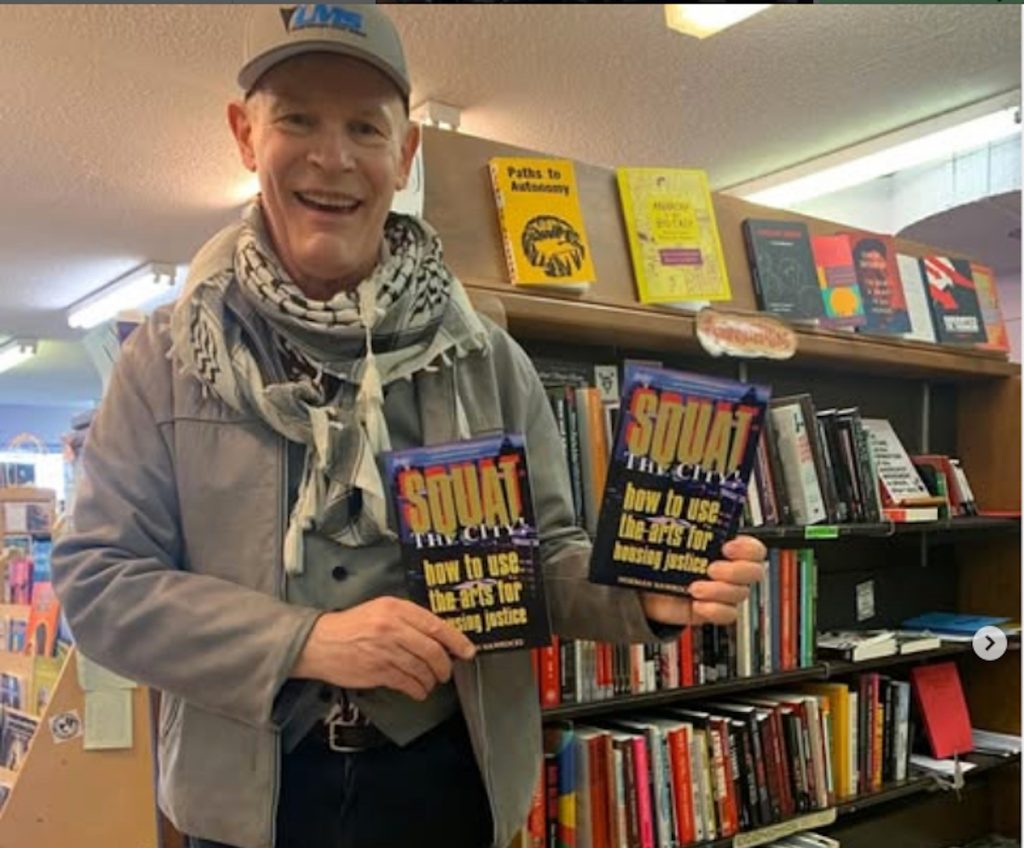
Recently, he turned his attention to nonfiction writing. His book, Squat the City! How to Use the Arts for Housing Justice, came out earlier this year from Kersplebedeb Books, and he is working on a more theoretical examination of the role that the arts can play in social movements, called Creative Resistance, which is due to be published next year.
The Media Co-op: What are a couple of important things that you have learned from struggles that you have never been personally involved in, or from approaches to activism and organizing that differ from yours, and why are they important to you?
Norman Nawrocki: Being inspired by other people’s struggles, where people just do not give up, but persist despite the odds, the fatigue, the burnout, the oppression, what the corporate media might be saying about them, and despite the laws that are enacted to try to stop them. About how people in diverse movements hang on and continue. For example, the Palestinian Youth Movement – I support them as much and as best I can. Just watching Palestinian youth here in Montreal devising diverse tactics, being so resilient in the face of police, politicians, and university repression, being able to maintain their position, their presence on the streets, on campuses despite every attempt to silence their voice. They continue to demonstrate and speak out and devise new ways to do that. But most importantly, it’s just the persistence, the dedication, the commitment. They show me (and others as well) what it takes, and what we as activists and organizers need to do.
Secondly, I haven’t been involved in tenant organizing recently, but now there’s a resurgence of tenant organizing across the country – a rebirth of tenants unions, which we haven’t seen for decades. People involved in these struggles are going door-to-door, speaking face-to-face, encouraging ordinary tenants who are confronted with asshole landlords to step out, speak up, join in a demonstration, and fight to win. It’s incredibly inspirational to see their growth and activity and successes for tenants. It is the face-to-face contact, the door knocking – “Hi, I’m a tenants’ rights organizer. I understand your landlord is giving you problems here. Would you like to talk about it? To join others in our group?” And then to see the results of that on the ground, where tenants now are collectively resisting rent increases and evictions here in Montreal and elsewhere, and winning. This is incredibly inspirational. Again, it underlines the importance of that face-to-face contact, that basic groundwork that needs to be done if we’re going to build community and a movement for housing rights.
A third source of inspiration for me from a movement that I wasn’t able to participate in was the Zapatistas working in Chiapas, Mexico – one of the first movements to contest neoliberalism in a very direct way starting in the 1990s. They picked up guns to confront the Mexican state. But first, they drove into the jungles with pickup trucks mounted with speakers blaring music to attract the attention of everybody around, to let them know that they were going to speak at the local plaza, the village plaza, in the middle of nowhere in these jungle communities. And then afterwards, there would be a fiesta. And people would come from all around to attend and listen to the speeches of the Zapatistas, to listen and talk about taking back land, about taking control of resources, taking control of everything the way it should be, in the hands of the people. And then they would party. People, of course, came because of the party originally, but in the process heard the speeches, listened respectfully, absorbed the messages, and the Zapatistas were able to build this incredibly successful, effective on the ground grassroots movement showing that all struggle doesn’t necessarily have to be serious or boring. That we could use music. That we could use dance, we could use fiestas, we could use a festive approach to organizing, to bring people in, to engage them, to inspire them, and again, to build community through that social interaction.
Finally, here in Montreal, we have an organization called the Immigrant Workers Centre. And they organize migrant workers, workers who are precarious workers, working under the table, in the dark, washing dishes, picking fruits and vegetables, doing whatever, in the worst possible conditions, where they can be threatened with deportation, with arrest. They can lose their jobs if they complain, lose their right to be here – even though they’re here without proper documentation, because they’re among the undocumented. But among them are documented but nonetheless exploited, marginalized workers, barely surviving, on the edge. So, the Immigrant Workers Centre has a cadre of union organizers. They go into the Amazon warehouses or out into the fields – again, face-to-face – and engage others in conversations about working conditions, about what the boss is up to, about what their rights are legally according to the law, about what they could be fighting for, and how it could be done. And they succeed in organizing workers on the ground, in the restaurants, in the factories, in the warehouses, and pulling together the nucleus of a union organization. They’re doing tremendous work. They are achieving results. They’re helping build this movement of workers that regular trade unions aren’t concerned with because they’re so marginalized, they’re off the radar. But the Immigrant Workers Centre knows that these are the people most in need of any kind of organizational support. Again, it’s feet-on-the-ground, face-to-face, engaged encounters, and very basic conversations in the language of the people that they’re trying to organize, that they’re trying to bring together.
TMC: What are a couple of sources related to struggles that you’ve never been involved in that you’ve found to be particularly useful or important for your own learning?
NN: It’s getting harder and harder for me to find those sources. It takes more and more time to scour the internet and try and figure out what are those sources. I’m spending a little more time, but trying not to spend too much time, on Bluesky and getting feeds there. And then tracking down the source of this or that piece of information that I can learn more from. At times the amount of information available – good sources, too – is overwhelming.
Once upon a time, there were a few basic print magazines, a couple of print newspapers that we would go to, and you knew that this was a trusted source of information, this was the alternative media, the underground media, the indie media. Now, there’s such a proliferation of activist sources online.
But for workplace sources, I go directly to the social media pages of the Immigrant Worker Centre. For the Palestinian Youth Movement, for activities to support Gaza, I go to the Palestinian Youth Movement site and all their related social media. For tenants rights organizing and housing justice organizing, I’ll go to the Montreal Autonomous Tenants Union social media pages. Of course, there’s always The Breach and The Media Co-op as well for my Canadian news fixes. Unrigged as well. And then the radio stations – I’m not much of a podcast person, but we still have alternative radio stations in Montreal. There’s one in English, CKUT based in the McGill University, with activist news programs. But I also try to follow Extinction Rebellion and now Meidas Touch on YouTube. Both great sources. And occasionally, I’ll check outIt’s Going Down or theWorking Class History podcast, or my newest discovery, the Channel Zero Network.
TMC: What are a couple of key things about struggles that you are or have been involved in, or about your approach to activism and organizing, that you would like other people to know more about?
NN: Most of my life now as an activist slash organizer has been focused on using the arts for social justice and community organizing. I teach this at colleges and universities. Sometimes, people bring me in to teach workshops. I work with trade unions and community groups as well, trying to share my experience as an activist, socially engaged artist, writer, performer, theatre person, producer, about how to use all the arts – whether it’s poetry, music, theatre, literature, film, dance, web art, or whatever – to address critical social issues today and reach more people. I believe quite strongly, after all my decades of experience in the field, that we can reach more people, we can amplify the voices of those directly involved in these struggles through the arts. And reach other people who may not be aware of them at all and help advance, help grow social movements.
I write about this now. For a long time, I was writing only fiction and poetry, but now I’m also writing books of nonfiction based on my ideas and experience. Because I believe that we need more creative resistance in the streets, on the rooftops, in places of work, in our communities, in schools, in our neighbourhoods, wherever people are fighting. And I believe that the arts used for this purpose can help people move forward. They can help people discover their own unexplored talent, penchant, capacity to be creative, and – combined with critical thinking and clearly stated organizing objectives – can reach more people in the process. And have fun also.
I base my creative work on what I see happening out there – real stories, real experiences, whether I read about it in the news, or hear about it on the street, or I run into somebody and they tell me their story. I spend a lot of time interviewing people, getting first person stories about, “How did this happen? How did you get involved in that?” Then transcribing and translating those stories into some sort of creative package, whether it’s a song, a poem, a theatre piece, a book, or a poster.
TMC: Particularly in more mainstream sources, you often see a sort of presumed opposition between the artist who is following an urge to create that emerges from within versus art made as part of collective struggles. But I have the sense in your artistic practice, and in lots of people’s practices, that it’s not experienced as an opposition at all. So talk about how you relate those two things.
NN: No, it’s not an opposition. When I do my creative work, it’s always a combination of my personal artistic motivation and an existing collective struggle. This means that I always have a point of departure that’s focused, that’s quite clear. We need to stop the pipeline, for example. The message is very simple. We need to end the exploitation of fossil fuels. We need to end financing pipelines. We need to stop this now. And that’s the point of departure. How to do this creatively is the challenge. And the fun part. So for me, the difference between this and me sitting here alone trying to think up something that maybe eventually could be used in some anti-pipeline fight – the difference is that I’m clear in terms of my point of departure. And I link it to the collective movement of environmental activists trying to do the same thing. And that gives inspiration – it enhances and enriches the inspiration, makes it more forceful, clearer, more present, gives me a clearer picture of what I’m working with.
When I work with other people, it’s sometimes in the context of a workshop for collective creation. For example, environmental activists. We say, okay, we want to stop the pipeline. We’re going to do something creative about it. This is our point of departure. The message is clear from the beginning. So we’ll build around that. That’s the inspiration. We’ll explore together, what are the thoughts, the words, the images that come to mind when we talk about stopping the pipeline? It’s not complicated. It’s not a PhD dissertation. It’s not presented in language that somebody’s grandmother couldn’t understand. It’s presented simply, clearly, forcefully, in a way that everyone can understand. If it’s a visual, the symbolism is simple but powerful. If it’s a song, the chorus is easily memorable and can be sung by anybody, and the melody is something that they can also follow. It’s not a complicated composition. The theatre piece to be performed is focused, visual, clear, simply presented, short, sweet, to the point, punchy. It could be 20 seconds long, less than a minute, and we’re out of there. It’s something that could be performed in the lobby of an oil giant’s corporate headquarters. Or in the middle of an RBC shareholders meeting. Then it’s over with, done, and nobody gets arrested because it’s presented as guerrilla theatre, tightly.
These are all factors that make a difference in terms of me creating art, and that’s in a very broad sense of the word – creating something where the objective is to pass along a message in a way that people will hear it, see it, absorb it, then go away and think about it and hopefully act on it as well. Because much of what I do is a call to action – to go into the street, to do something to stop this landlord, that pipeline, the destruction of this green space. The role of the artist is not only to witness but also to create a force through their art that helps change what’s wrong. That helps stop what needs to be stopped. That helps shed light on something that people want to keep a secret, or articulate or amplify a message. That helps mobilize people, bring them together, to fight whatever needs to be fought.
TMC: What are a couple of sources related to struggles that you are involved in or to your approach to activism and organizing that you would want other people to read, or watch, or listen to, or otherwise learn from?
NN: For example, for housing justice, I strongly suggest people look up the tenants unions in their respective cities and follow them, join them, support them even if they can’t be there physically in person. But in whatever way, support them – online, with money, with resources, with connections, with tech help, whatever. Every city and town in Canada is confronted with a crisis in housing that’s manufactured, obviously, because of the financialization of the market. The community groups that are resisting need support now to keep fighting this. Go directly to their social media sites to follow them.
People can follow me on Instagram, Facebook, Bluesky, my YouTube channel and my blog to see my work and how it relates to broader struggles and other groups. Or just visit my Linktree.
Kersplebedeb Books, a left-wing publisher here in Montreal, just published my first nonfiction book, called Squat the City! How to Use the Arts for Housing Justice. It’s a book that can be used by anybody in any social movement, not just housing. I distill my decades of experience on the front lines working with community organizations, addressing housing issues, using theatre, music, poetry, visual art, to raise public awareness, to help mobilize people, and to help resolve the problem. It’s full of examples, history, ideas, lessons, advice, and practical suggestions. It’s also full of inspiration for anybody who wants to get involved either in the housing justice movement, or for people already involved in other social justice movements who want to expand their toolkit and maybe try different approaches. Like exploring the potential for creative resistance in their work.
Next year, I have a book coming out called Creative Resistance, which expands on my broader theories and practice beyond the housing justice movement. The new book will explore the theory behind creative resistance. Like, how did we come up with this? It’s not new, obviously. It’s a practice that goes back centuries, to the slave trade and the building of the pyramids, when workers were creative in their resistance to the slave drivers.
I have other books, books of fiction, where I use literature to address vital issues and where people can learn from these books lessons still applicable today, for any new form of social justice practice, for whatever issue people may be involved in. But I have also written theatre pieces, collections of poetry, and released some seventy albums of music, mostly with radical spoken word.
I guess the key thing for me is learning from our history. And I’m old enough now to say, okay, I have all this history to share and I’d like people to learn from it. Because I don’t want people repeating the same mistakes we might have done before, or spending time trying to figure things out when we actually figured that out before.
Scott Neigh is a writer, media producer, and activist based in Hamilton, Ontario. You can pre-order his new book, Listen! Knowing the World and Fighting to Change It, out from Fernwood Publishing in October 2025.