(Originally published at The Media Co-op.)
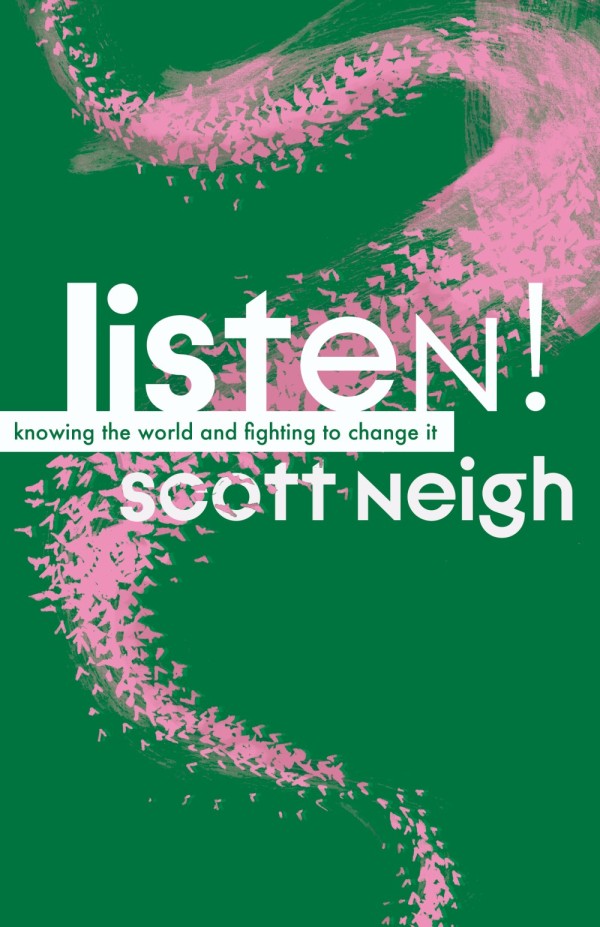
Editor’s note: We are pleased to be publishing an excerpt from Listen!: Knowing the World and Fighting to Change It, by Scott Neigh, who is also a Media Co-op editor. In the book, Neigh, drawing on his extensive experience interviewing people who are active in social movements, examines how listening shapes who we are, how it weaves the world together and how it grounds our movements for justice and liberation. This excerpt, lightly edited, is from a section within the chapter “Listening to each other” and is titled “Listening and making change.”
Listening and making change
Given how central listening to each other is to the formation of a collective we, to knowing, and to doing in general, it should be no surprise that this is also true of our collective efforts to change the world for the better.
We examine the interrelation of listening and social movements in more detail later in the book, but consider for a moment the visions for change — rich, far-reaching, and diverse — to be found in the words of many differently situated organizers, activists, revolutionaries, and radical thinkers.
If you slice through what they say, you will find perhaps mentions of and inevitably pointers towards listening in their imaginings of future worlds, in the we they think is necessary to get there, and in their understandings of how change happens. They might not use the language of “listening” directly, but if you pay close attention, the presumption of it is not just present but pervasive.
The work of many radical Indigenous writers who envision paths towards liberatory Indigenous futures — and I’m thinking specifically of Leanne Betasamosake Simpson and Pamela Palmater, but it is true of many others — talks in part about the relations called for in both those futures and the struggles to reach them. Certainly, the work of building “relationships based on deep reciprocity, respect, noninterference, self-determination, and freedom” (Simpson) or ways of work grounded in “patience, listening, and understanding multiple perspectives by hearing from all voices who want to be heard” (Palmater) clearly and centrally require listening. Those seem to be elements of larger visions that prioritize a deep and profound practice of responsiveness in life and in struggle that is consistent with my use of the word “listening,” even as it exceeds it.
Or you can look to the writing of mid-twentieth-century Guinean anti-colonial revolutionary Amilcar Cabral. This is perhaps the most broadly circulated quote from his work: “Hide nothing from the masses of our people. Tell no lies. Expose lies whenever they are told. Mask no difficulties, mistakes, failures. Claim no easy victories.” In its exhortation to a revolutionary honesty, it is premised not only on communication by those at the centre of the struggle but on the broader colonized population taking in, taking up, and acting on those words as they move along the fraught path towards liberation. He also calls for a commitment to constant listening on the part of revolutionaries themselves: “Learn from life, learn from our people, learn from books, learn from the experiences of others. Never stop learning.” In multiple senses and multiple directions, listening is, for Cabral, a key part of the how of change.
Migrant justice organizer Harsha Walia writes of the role of non-Indigenous people in struggles for decolonization, recognizing that “support” and even “solidarity” are not enough, but rather that a deeper and more sophisticated approach to being in relation is called for and that such work “requires us to challenge a dehumanizing social organization that perpetuates our isolation from each other and normalizes a lack of responsibility to one another and the Earth.” Whatever else that involves, it sounds like greater listening to each other and to the world is one element.
Prominent Canadian feminist Judy Rebick speaks of how central learning to listen to other women has been to her experience of feminism. Radical Montreal-based musician Norman Nawrocki passionately argues for activists and organizers to do more to integrate music and the arts into their work, in part because of their capacity to catalyze listening in new and different ways. Famous community organizer Saul Alinsky warns of how important it is not just to talk at the people you are trying to organize, but to listen to them long and well.
Abolitionist organizers Mariame Kaba and Kelly Hayes emphasize the centrality of listening in movement building: “It is our ability to constructively engage with other people that will ultimately power our efforts. … And that skill of constructive engagement starts with listening.” Long-time revolutionary anti-fascist Michael Novick, activists and writers Leah Hunt-Hendrix and Astra Taylor, Marxist intellectual Vijay Prashad, US-based radical adrienne maree brown, and many, many others also identify a role for listening in their respective political visions.
An entire book could be written tracing a genealogy of shifting practices and modes of listening across different movements, eras, and struggles for change, and different radical thinkers, though I will leave that project for someone else. I suspect as well that many political critiques among and across the diverse movements and traditions touched on above could be reframed as arguments about how, when, and to whom listening should be happening. But, nonetheless, for all of them, listening plays a role — and much of that is the listening we do to each other.
Scott Neigh is a writer and media-maker based in Hamilton, Ontario. His latest book is Listen! Knowing the World and Fighting to Change It (Fernwood Publishing, 2025).