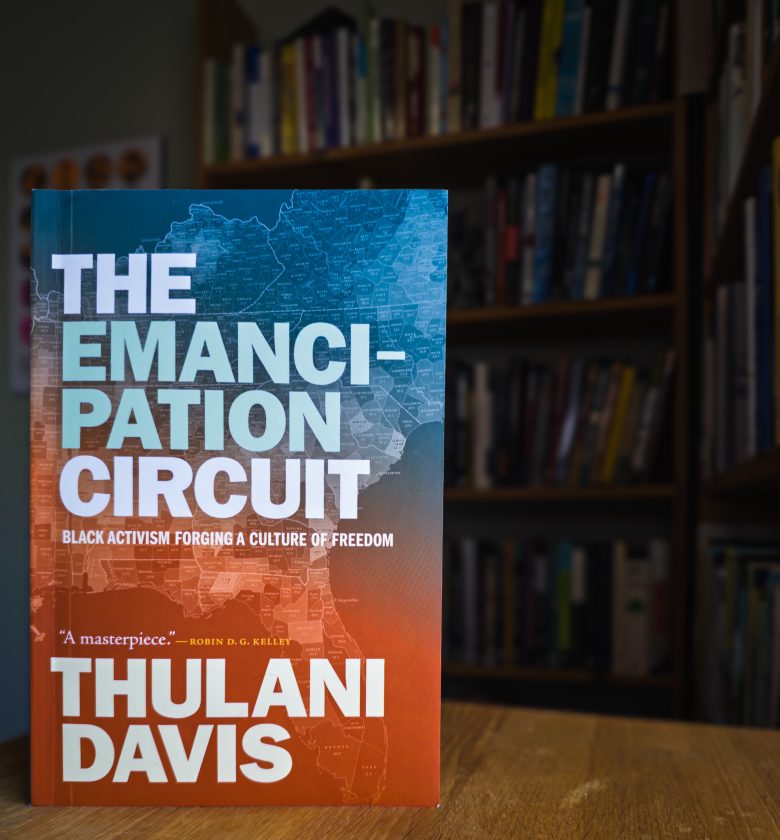
Creating Through the Crisis #28 – The Emancipation Circuit: Black Activism Forging a Culture of Freedom by Thulani Davis
Despite how much I’ve thought about it over the years, I don’t feel like I have a very good answer to the question of what a piece of writing can do in the world, in a life, in my life. I don’t know what I would say to someone who was setting out to, for example, write some history and make it matter to everyday lives and collective struggles in the present, or to someone else who wanted to read history of that sort. What does it really mean to think that learning about things that happened a hundred years ago, a thousand years ago, might be relevant to living life and fighting for change today? I dunno. But, still, I think this book is those things.
This is an academic history of Black organizing in the US south during and after the Civil War, particularly in that brief era of nascent multi-racial democracy between emancipation and the stabilization of a new regime of explicit, institutionalized white supremacy that lasted until the 1960s. The approach and the writing are careful, methodical, and staid — in other words, well done but not necessarily exciting in terms of craft — but it’s the content that’ll get you. I’ve always done my best to remember that even if you can’t see it from the outside, there are always things going on within communities in response to exploitation and oppression, but I still found myself repeatedly amazed by the sheer scale and intensity of the plunge into collective organizing by newly freed people that is documented in this book. (Indeed, it makes the point multiple times that free Black activists from the north who went south to be part of the struggle were regularly amazed by this too.)
A key thesis of the book is that there was a circuit of ideas and practices and people and energy and mobilization across key parts of the south that often reflected where Union troops had been stationed in the late stages of the war — many enslaved people escaped to these places and the federal military presence at least sometimes provided some initial safety to organize — as well as existing transportation networks. And the book argues that this flowering of organizing not only produced new groups that were about mutual aid, collective self-defence, and political participation, but also helped forge an underlying sensibility and regime of knowledge in Black communities in the south that has been a basis for repeated waves of grassroots activity across generations, even as specific organizations have come and gone and political circumstances have changed drastically.
In my ongoing reflection on how we can, for instance, learn from the past for living and struggle today, one of the things I’ve come up with is this sense that it is almost never a matter of simple lessons from then turned into simple actions now. Rather, it’s more often the account of the past enabling us to imagine in a complex, social way how something or other went down, and then that complex, social imagination informing in a complex, social way some aspect of how we think about the present.
One level of this is very direct — I think just on its own, sitting for awhile with that amazement and respect for how newly freed Black communities took action in those years is useful and important. It’s a real lesson, a real reminder that people can, people will, people do.
As well, I think there is lots of fodder in this book for thinking about questions of victory and defeat, and for thinking about the power of the state. As horrific as the Civil War was, emancipation was one of the most profound victories in the history of the United States. Yet within a decade or two, the planter class and organized white supremacy were able to establish a new regime of domination. The lesson (or, at least, a lesson) from that isn’t just about betrayal by white liberals from the North, though that was certainly a huge factor. It is also about how power works. The domination that was slavery didn’t just exist in a state form and a set of laws that could be vanquished, but was distributed through the practices and the very selves of those who benefited from that white supremacy and had always been told that it was righteous that they do so. Those among that population who already had a great deal of economic power were mostly allowed to retain it, and there was also a widely distributed willingness to use horrific judicial and extrajudicial violence to maintain dominance. With those two things, though their hold on local and regional state power was to some extent shaken by losing the Civil War, they were able to regain it. There are things to learn here that are relevant to struggles for collective liberation in a lot of other contexts. And none of it is simple or easy.
And even beyond that, what does it mean about what victory for collective struggle looks like? Or even what defeat looks like? It’s a lot more complicated than it sometimes appears.
I think there are also things to learn about how the southern reactionaries in the 1860s, ’70s, and ’80s deployed state power that are relevant to what the Trump regime is doing today. There’s lots that’s very different — state practices are vastly different as a whole now than then, the goals and targets aren’t the same, the overall situation is very different. But there’s something similar, too, about the broadly shared devotion to a specifically white patriarchal nation among reactionaries then and now, and about their creative and utterly ruthless use of any and every lever of the state, as well as their recourse to judicial and extrajudicial violence. There are things to learn from looking at that history, and at histories of resistance in that context.
And I think there are also things to learn about…well, I guess about the scale of the stakes. And obviously, there are lots of people who are most directly impacted by what the Trump administration is doing who are very, very, very well aware of this. But I think lots of other people who are horrified by what is going on in the US haven’t necessarily grasped the full scope of what reactionaries are trying to do. The ruthless use of state and extra-state violence in the south produced a regime of domination that lasted for something like 80 years before Black struggle broke its hold, and that kind of historic defeat of liberation of all sorts is what reactionaries in the US are aiming to impose today. I don’t think that outcome is at all a foregone conclusion in today’s context — again, admitting the vast differences between then and now, acknowledging the evidence that there is a certain fragility and frantic weakness evident in the horrid ways the Trump regime is exercising power, and fully believing the movement mantra that “we will win.” But that’s what they’re aiming for. And as the history of the post Civil War era shows, we can’t rule out the possibility that they might achieve it.
But, of course, there’s also lots to be learned from that history about what it looks like to support your neighbours, to get together in groups and ask “what can we do” even when you’ve never done that before, and then to do what needs to be done. There’s lots to be learned about solidarity, and about betrayal enacted to protect white privilege. There’s lessons about how far the powerful will go to preserve that power if they genuinely believe that it’s threatened. And there’s lessons about how building organizations and taking action collectively impact the current moment but also mean, regardless of how that current moment unfolds, that the next wave of resistance will start from a position that’s a little further ahead than it otherwise would have — that resistance matters and contributes to a better future even if it doesn’t initially win.
None of this is simple, of course. There are no one-to-one parallels, no directly appropriable tools from 1870 that can be copied and pasted into 2026. But I still think there is useful learning to be done from this book. After all, it’s a history of amazing organizing and heartbreaking repression, and that feels relevant to today.